



Product Description
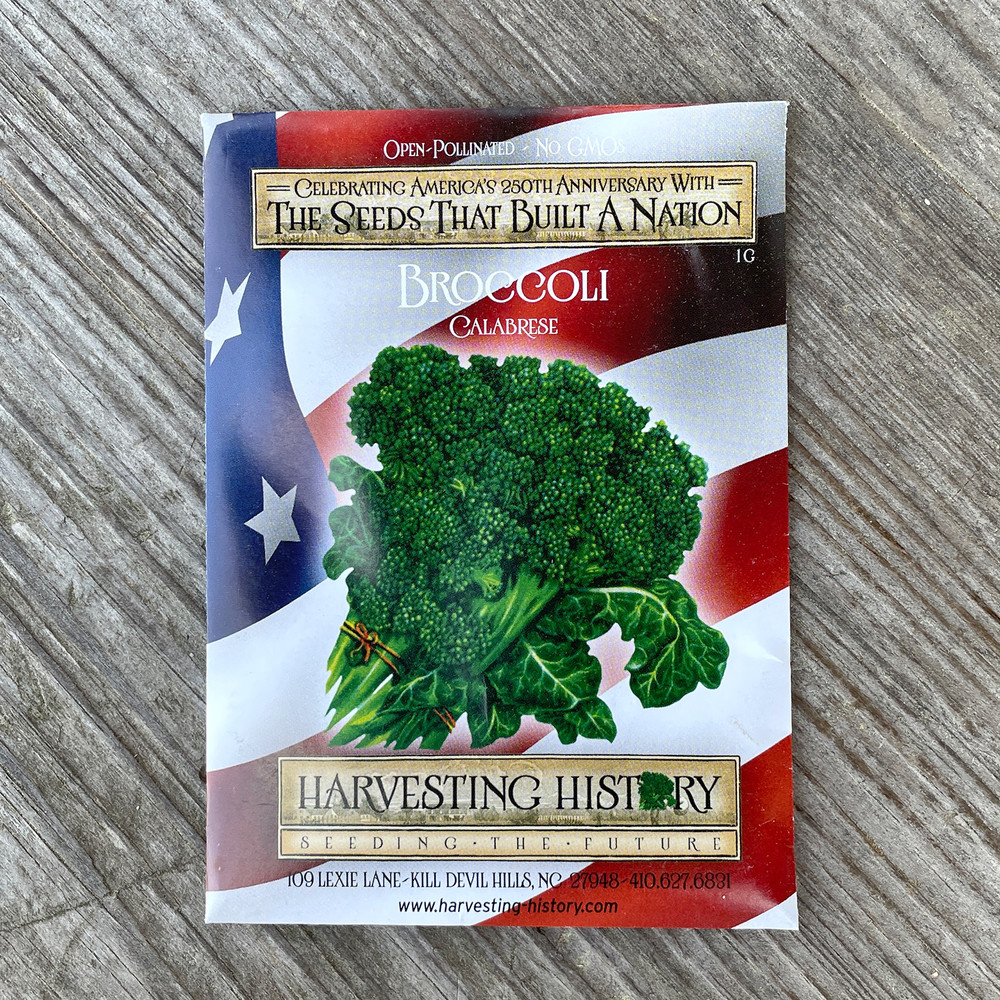
Calabrese Sprouting Green Broccoli initially forms a large, green head, usually 6-8 inches in diameter. Once the head has been harvested, it will produce green sprouts prolifically until early to mid-winter. Broccoli can be sown in the early spring for a summer crop and in early summer for a fall crop. The 18-30 inch tall plants tolerate frost very well. These heirloom broccoli seeds are part of The Seeds That Built America collection by Harvesting History and are made in the USA!
Planting and Care
Broccoli can be sown in the early spring for a summer crop and in early summer for a fall crop. In the spring, plant as soon as the ground can be worked. Soil should be deeply spaded before planting. Adding lime to the soil before planting will sweeten broccoli.
Plant seeds at a depth of 1 inch, 18 inches apart. Rows should be 30 inches apart. Seeds germinate in 10 days. When seedlings are 2 in. high, thin to 18 inches between plants. Plants reach maturity in 75 days. Maintain even, moist soil conditions with a consistent watering schedule, providing 1-1.5 inches of water each week.
Inspiration
Calabrese Green Sprouting Broccoli (Brassica oleracea var. italica) is native to Europe and Asia. Two distinctly different plants carry the name. One forms a head similar to a cauliflower, and the other forms sprouting side shoots.
The older variety, Italica, called sprouting or asparagus broccoli, is thought to have developed from a form of European wild cabbage and originated in the Eastern Mediterranean.
It had reached Italy by the 17th century. As it spread to Northern Europe, it became known as Italian Asparagus. Italian immigrants brought broccoli to the United States in the early 1800s.
Eighteenth-century Williamsburg was the home of many ardent gardeners and plant collectors who often exchanged seeds with fellow enthusiasts in Great Britain. Gardeners obtained their seeds from store merchants or from traveling seedsmen. Today, the Colonial Williamsburg seed program continues the tradition by offering many varieties grown in the 18th century.