



Product Description
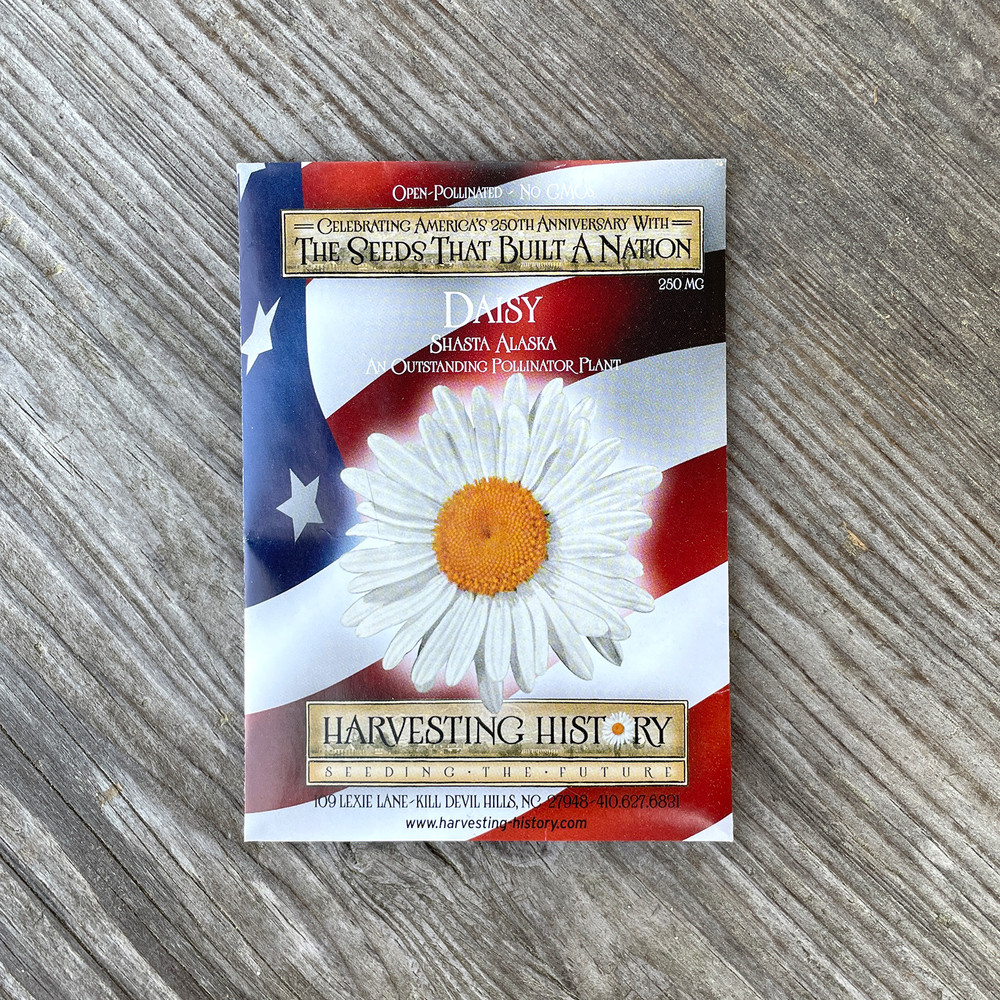
Shasta Daisy Alaska is a legendary American garden flower. It was the first garden flower bred for specific characteristics by America's foremost plant breeder, Luther Burbank. Today, the Shasta Daisy Alaska is the oldest hybridized American garden flower in existence. The Shasta Daisy is a clumping perennial that spreads through rhizomes (roots just under the soil surface), promoting prolific spreading and reseeding for excellent ground cover over large garden beds. They look spectacular when in full bloom at the height of summer and are outstanding pollinators. These Heirloom Shasta Daisy Alaska Seeds are part of The Seeds That Built America collection by Harvesting History and are made in the USA!
Planting and Care
Plant in a location with full sun. Broadcast (or scatter) seeds over the surface of the planting area in spring after the danger of frost has passed. Seeds will germinate in 10-14 days and begin blooming in July. Well-drained and fertile soil amended with compost works best for Shasta Daisies. Slightly moist soil with a neutral to slightly alkaline pH is ideal. They thrive in sandy, loamy, or clay-loam soils with good drainage to avoid "root rot".
Inspiration
Luther Burbank grew up in Massachusetts in the late 1800s. Burbank loved the bright little faces of the invasive weed known as the Oxeye Daisy. He loved the whiteness of the petals, the brightness of their yellow "eyes," and the fact that they grew everywhere.
His admiration was not shared by the local farmers who fought to control the weed throughout their growing seasons. In 1884, Burbank bought a farm near Santa Rosa, California, and began breeding programs with several flowers and vegetables, but one of the most important was a breeding program he designed to create the perfect daisy.
In total, it took 15 years to develop Burbank's perfect daisy, which he named the Shasta Daisy after the glowing white, northern California mountain, Mount Shasta. Burbank introduced the species in 1901, and in 1904, he announced the first named varieties: Alaska, California, and Westralia.
Eighteenth-century Williamsburg was the home of many ardent gardeners and plant collectors who often exchanged seeds with fellow enthusiasts in Great Britain. Gardeners obtained their seeds from store merchants or from traveling seedsmen. Today, the Colonial Williamsburg seed program continues the tradition by offering many varieties grown in the 18th century.